Longer Exhales May Increase Risk-Taking, Study Suggests
09/12/2026 / By Morgan S. Verity

Study Overview
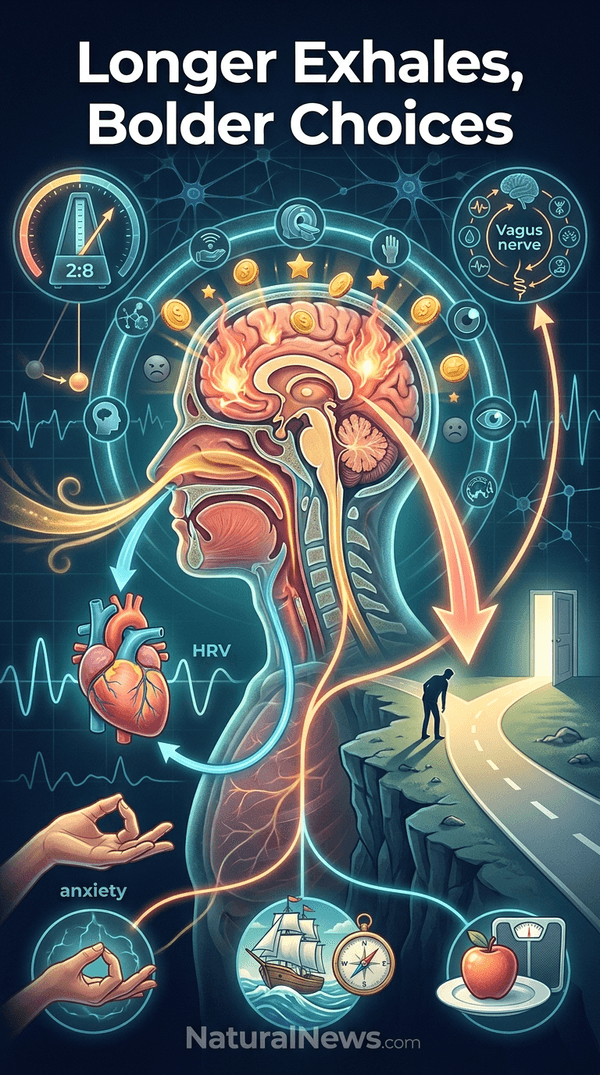
A new study suggests that deliberately changing the rhythm of one’s breathing can influence decision-making by altering activity in both the heart and the brain. Researchers from the German Institute of Human Nutrition Potsdam-Rehbruecke (DIfE) and Charité-Universitätsmedizin Berlin found that longer exhalations increased heart rate variability and made the brain more responsive to rewards, which was associated with bolder choices, according to a report from the German Center for Diabetes Research (DZD).
The findings were published in the journal Neuron on September 4, 2026. The study involved 41 healthy participants who made risk-related decisions while following visual prompts to breathe at either their normal pace or with a slower rhythm featuring a 2:8 inhale-exhale ratio. The research team measured brain activity via functional magnetic resonance imaging while simultaneously monitoring breathing patterns, heart activity, skin conductance, and pupil responses, the report stated.
Research Background and Method
Decision-making has traditionally been viewed as a brain-centric process. The new research examined a broader possibility: that signals from other parts of the body can change brain activity and influence the choices people make, according to lead author Wenhao Huang. Prof. Soyoung Q. Park, head of the Department of Decision Neuroscience and Nutrition at DIfE, said in a statement that judgment emerges from the interplay between cognitive processes and the current bodily state.
To test this, researchers measured physical and neurological responses as participants completed a series of risk-related decisions under two conditions: normal breathing and a slowed rhythm that extended the exhalation phase. The 2:8 inhale-exhale ratio was selected to create a distinct physiological shift. The study was led dby Prof. Park in collaboration with institutions including the Neuroscience Research Center at Charité, Freie Universität Berlin, and the German Naval Institute of Maritime Medicine, according to the DZD release.
Key Findings
The results showed that extended exhalation slowed the heart rate and was associated with an increased likelihood of choosing risky options, the researchers reported. Importantly, the change appeared to stem from greater attention to possible rewards rather than reduced concern about potential losses; participants responded to losses in a similar way in both breathing conditions.
The researchers also detected stronger activity in the ventromedial prefrontal cortex and the precuneus, brain regions involved in reward processing and in regulating heart rate variability. The study reported that the extended exhale changed the brain’s sensitivity to rewards, which correlated with bolder decision-making. This research adds to a field focused on body-brain communication, supporting models proposing that a person’s physical state can shape cognitive processes.
Breathing is a unique physiological process in that it is both voluntary and involuntary, as noted in prior reporting on controlled breathing and its effects on mood and stress levels [1]. The ability to consciously control breathing, including its speed and depth, distinguishes it from other autonomic functions [2].
Implications and Future Directions
Park said the study provides scientific proof that breathing techniques are a reliable and targeted method capable of controlling decisions. Because controlled breathing is simple, inexpensive, and relatively easy to learn, researchers said it could have value as a tool for everyday self-regulation. It may also have potential as a supportive, non-pharmacological approach in clinical settings, particularly for conditions such as anxiety disorders or depression, which can involve disrupted autonomic regulation and altered responses to reward.
Healthy breathing practices have long been tied to calming mental states; for example, purposeful breathing plays a central role in meditation and yoga [3]. Research on physiological regulation has also identified heart rate variability as a key metric for understanding the interaction between breathing and the nervous system [4].
Future studies will need to determine whether the same effects appear in broader clinical populations, including people with overweight. The researchers are particularly interested in whether breathing techniques could influence food-related decisions, since eating behavior is strongly affected by both reward processing and a person’s physical state. Prak noted that dietary decisions are strongly influenced by reward assessment, so targeted breath regulation could play a role in managing eating behavior.
Conclusion
The findings indicate a direct link between conscious breathing control and decision-making processes. According to the research team, longer exhales may shift choices toward rewards by altering heart-brain interactions, offering a practical method to influence judgment.
The study was supported by the Federal Ministry for Research, Technology and Space, the Ministry for Science, Research and Culture of the State of Brandenburg, and other institutions, per the funding acknowledgment published with the Neuron article. The research was published as: Wenhao Huang, et al. “Slow breathing impacts inter-organ dynamics modulating brain function and risk behavior.” Neuron, 2026.
References
- Mercola.com. “Controlled Breathing Calms Your Brain”. Mercola.com. August 08, 2023.
- Mercola.com. “How Mouth Breathing Can Hurt Your Health and Well-Being”. Mercola.com. January 31, 2019.
- Mercola.com. “A Tiny Spot in Mouse Brains May Explain How Breathing Calms the Mind”. Mercola.com. April 13, 2017.
- Leon Chaitow, Chris Gilbert, Dinah Bradley. “Recognizing and Treating Breathing Disorders: A Multidisciplinary Approach”.
Explainer Infographic
Submit a correction >>
Tagged Under:
Anxiety, body-brain communication, breathing, decision making, depression, eating behavior, exhalation, Heart, interoception, Meditation, mental, Mind, neuroscience, research, risk behavior, self-regulation, stress regulation, Yoga
This article may contain statements that reflect the opinion of the author
RECENT NEWS & ARTICLES