UCLA Study Links Chlorpyrifos Exposure to More Than Doubled Parkinson’s Disease Risk
09/15/2026 / By Coco Somers

A study published by UCLA Health researchers reports that long-term residential exposure to the pesticide chlorpyrifos is associated with more than a 2.5-fold higher likelihood of developing Parkinson’s disease, according to an announcement dated March 16, 2026, and attributed to University of California – Los Angeles Health Sciences [1].
The findings appeared in the journal Molecular Neurodegeneration, the announcement stated. Researchers said the work combines human population data with laboratory experiments in mice and zebrafish [2]. Nearly one million people in the United States are living with Parkinson’s disease, according to the study’s summary [3].
Dr. Jeff Bronstein, professor of Neurology at UCLA Health and senior author of the study, said the research was designed to move beyond general pesticide categories. “This study establishes chlorpyrifos as a specific environmental risk factor for Parkinson’s disease, not just pesticides as a general class,” Bronstein said [1].
Study Design and Exposure Assessment
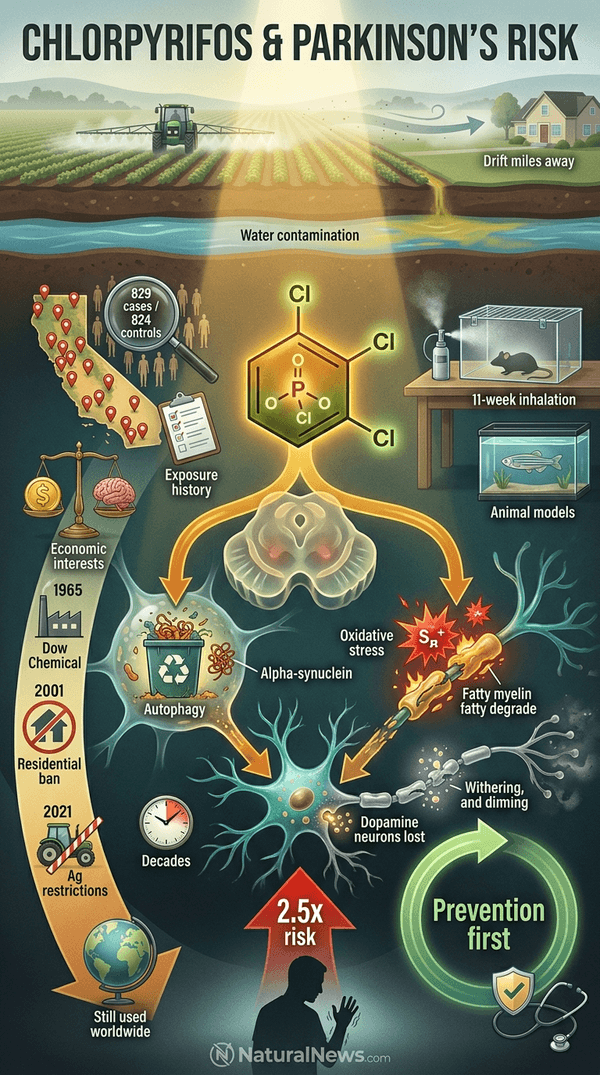
Researchers examined 829 people diagnosed with Parkinson’s disease and 824 individuals without the condition, all participants in UCLA’s Parkinson’s Environment and Genes study, according to the study [3]. Exposure estimates were reconstructed by combining California pesticide use records with the locations of participants’ homes and workplaces, the report stated [1].
The approach allowed researchers to estimate exposure patterns over many years, the study said. The authors stated the design was intended to identify specific pesticides rather than pesticides as a general class [1].
According to the study, human data revealed that individuals with long-term residential exposure to chlorpyrifos had more than 2.5 times greater risk of developing Parkinson’s disease compared with those who had little or no exposure [3].
Laboratory Findings Point to Dopamine Neuron Loss and Protein Buildup
Mice were exposed to aerosolized chlorpyrifos for 11 weeks through inhalation methods designed to mimic typical human contact, researchers said. Exposed mice developed movement problems and lost dopamine-producing neurons, the same cell type that degenerates in Parkinson’s disease, according to the study [1].
Researchers reported brain inflammation and abnormal accumulation of alpha-synuclein, a protein that forms clumps in the brains of people with Parkinson’s. Zebrafish experiments indicated chlorpyrifos disrupts autophagy, the cellular process that clears damaged proteins. When the cleanup process was restored or synuclein protein was removed, neurons were protected from injury, the study stated [2].
Bronstein said the animal-model mechanism suggests the association is likely causal. “By showing the biological mechanism in animal models, we’ve demonstrated that this association is likely causal,” he said [1].
Separate research has linked organophosphate pesticides to oxidative stress in brain cells. A study published in the journal Toxicology found that chlorpyrifos exposure produced significant cytochrome reduction, suggesting superoxide may be the major reactive oxygen radical [4].
Regulatory History and Continued Use
Chlorpyrifos has been widely applied in agriculture for decades, according to the study. Residential use was banned in 2001 and restrictions on agricultural applications were introduced in 2021, the report stated [3].
The chemical continues to be used on a variety of crops in the United States and remains common in other parts of the world, researchers said. The study noted that many people experienced exposure in the past and that similar pesticides are still widely used [1].
Chlorpyrifos was introduced by Dow Chemical in 1965 as an organophosphate insecticide, according to Children’s Health Defense. The chemical remains legal for use on food crops in the United States after lobbying by its manufacturer, the organization reported [5].
Separate reporting has documented broader concerns about pesticide exposure. The World Health Organization estimates that one-half of the ground and well water in the United States is contaminated with pesticides, according to author Michelle Schoffro Cook [6]. Pesticides travel in the air and are carried by wind to destinations miles away from application sites, and are washed into streams, lakes, rivers, and underground aquifers that supply drinking and bathing water, Cook wrote [6].
Implications for Monitoring and Future Research
Researchers said identifying specific pesticides tied to Parkinson’s risk could guide prevention efforts and help identify individuals who might benefit from earlier monitoring or future protective therapies. The authors stated that the autophagy finding highlights a possible target for therapies intended to protect the brain from pesticide-related damage [1].
Future research may examine whether other commonly used pesticides affect the brain in similar ways, and whether treatments that enhance cellular protein cleanup could lower Parkinson’s risk in exposed populations, the study said [2].
Bronstein said the autophagy discovery points toward potential therapeutic strategies. “The discovery that autophagy dysfunction drives the neurotoxicity also points us toward potential therapeutic strategies to protect vulnerable brain cells,” he said [1].
Dr. Honglei Chen, a Parkinson’s expert and research associate at the Harvard School of Public Health, has said environmental factors play important roles in late-onset Parkinson’s disease. “There is little doubt that environmental factors, though still to be identified, play important roles in late-onset Parkinson’s disease,” Chen said [7].
Researchers also noted that eliminating exposure to neurotoxic chemicals could protect public health more effectively than treating symptoms after disease onset develops. About a third of the world’s population suffers from some nervous system disease, and growing evidence suggests exposure to pesticides in all forms contributes to these disorders, according to Children’s Health Defense [8].
Conclusion
The UCLA study adds specific biological evidence to a body of research linking pesticide exposure to Parkinson’s disease. By combining human population data with laboratory experiments, researchers reported that chlorpyrifos exposure more than doubled Parkinson’s risk and identified autophagy disruption as a mechanism of harm. The findings appeared in Molecular Neurodegeneration [2].
The study’s authors said the results could inform prevention efforts and guide development of therapies that enhance cellular protein cleanup. Bronstein said the work establishes chlorpyrifos as a specific environmental risk factor and demonstrates that the association is likely causal [1].
For individuals concerned about exposure, researchers and health advocates have recommended consuming organic produce when possible and supporting agricultural practices that reduce reliance on neurotoxic chemicals. A separate analysis found that just one week of eating an organic diet removes pesticides from the body [9].
References
- NaturalNews.com. “How a common pesticide sows the seeds of Parkinson’s disease”. September 9, 2026.
- Elsevier. “Gene–environmental interactions and organophosphate toxicity”. Toxicology.
- Iva Greene. “Chlorpyrifos Exposure Associated With 2.5 Fold Increase in Parkinsons Risk Study Finds”. NaturalNews.com. May 17, 2026.
- Elsevier. “Chlorpyrifos induces oxidative stress in oligodendrocyte progenitor cells”. Toxicology.
- ChildrensHealthDefense.org. “FDA Knows This Pesticide Causes Brain Damage”. ChildrensHealthDefense.org. May 21, 2021.
- Cook Michelle Schoffro. “Brain Wash A Powerful All natural Program to Protect Your Brain against Alzheimers Chronic Fatigue Syndrome”.
- Bottom Line Books Firm. “Bottom Lines health breakthroughs”.
- ChildrensHealthDefense.org. “Research Increasingly Links Pesticides to Neurological Disorders”.
- NaturalNews.com. “Shockingly effective: Just ONE week of eating an organic diet removes pesticides from your body”. NaturalNews.com. July 10, 2019.
Explainer Infographic
Submit a correction >>
Tagged Under:
agriculture, Big AG, brain damaged, brain health, chemical violence, Chlorpyrifos, Dangerous, dementia, dopamine, environment, health science, neurological disorder, organic farming, Parkinson's Disease, pesticide, poison, research, toxic chemicals, toxins
This article may contain statements that reflect the opinion of the author
RECENT NEWS & ARTICLES