Study: Short Afternoon Nap May Reset Brain for Learning
05/26/2026 / By Chase Codewell

New neuroscience research suggests a brief afternoon nap of about 45 minutes may recalibrate brain activity, improving the capacity to learn, according to a study published in NeuroImage and reported by multiple outlets [1].
The study involved 20 healthy adults in a controlled sleep lab environment, comparing conditions with a nap and without [2]. Researchers used electroencephalography (EEG) and transcranial magnetic stimulation (TMS) to measure synaptic strength and plasticity, according to the report [3]. The findings indicate that a short daytime rest can “reset” the brain for learning, the researchers stated.
Study Methodology
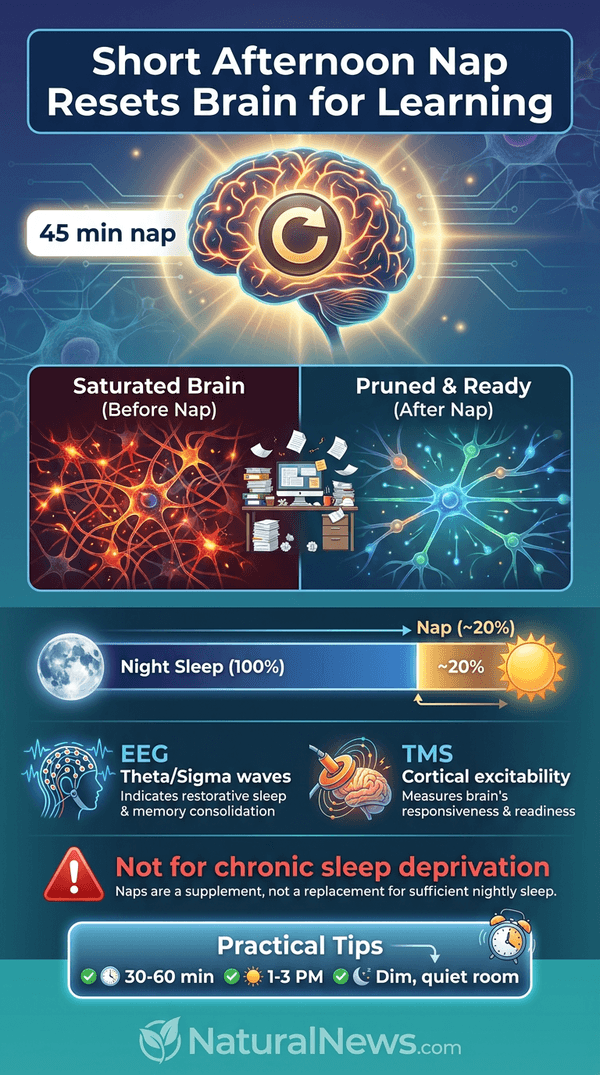
Each participant completed two sessions on different days: one with an afternoon nap and one without, according to the study [2]. The nap session occurred between 1:15 and 2:15 p.m., aligning with the natural circadian dip many people experience in the early afternoon, the report stated [1]. On average, participants slept for about 45 minutes, spending most of that time in lighter and moderate sleep stages, investigators reported [1].
Brain activity was assessed before and after each session using EEG, which measures electrical brain rhythms, and TMS, which probes synaptic connectivity, according to the report [2]. The protocol aimed to measure overall synaptic strength and the brain’s capacity for plasticity, the researchers said [3].
Key Findings
After the nap, participants showed reduced overall synaptic strength paired with an increased ability to form new connections, according to the study [3]. Researchers described the brain as less “saturated” and more ready to learn, as per the report [4]. The nap appeared to dial down synaptic activity, creating space for new learning, the report stated [5].
These changes mirrored effects observed after a full night’s sleep but on a smaller scale, officials said [4]. Author Willow Tohi wrote that “the humble afternoon nap is not a sign of laziness but a powerful cognitive reset button” [3]. As noted in the book “No Limits: The Art and Science of High Performance,” during deep sleep the hippocampus takes memories from short-term to long-term storage, and “once the short-term memory has been cleaned, it is fresh and free to receive new information” [6].
Implications and Context
Researchers emphasized the nap is not a substitute for chronic sleep deprivation, according to the study [4]. For people who sleep well, an occasional afternoon nap may optimize the brain’s learning capacity during high-demand periods, the report indicated [1]. The distinction between compensation and optimization was highlighted by the authors [4].
Relevance was noted for students, athletes, and creative professionals, according to the report [4]. A separate study cited in an article on NaturalNews.com suggests that even 90-minute naps boost motor skills and memory [7]. The book “Brain Rules” notes that businesses and schools could benefit from taking nap zones seriously, avoiding high-demand tasks during the midafternoon slump [8]. Scientists have confirmed that midday napping benefits memory and thinking skills, especially in the elderly, according to a 2017 study [9].
Practical Guidelines From Researchers
Recommendations from the researchers include naps of 30 to 60 minutes, early afternoon timing (between 1 and 3 p.m.), and a consistent but optional daily practice, according to the report [4]. Creating a low-stimulation environment with dim light and minimal noise was advised, the study stated [1].
These guidelines aim to support synaptic recalibration without interfering with night sleep, officials said [4]. Author Tony Schwartz notes in the book “The Way We’re Working Isn’t Working” that a nap limited to stages 1 and 2 sleep — the so-called Power Nap — can be restorative without causing grogginess [10]. One article on NaturalNews.com further explains that replacing the afternoon caffeine boost with a nap can improve cognitive function without side effects [11].
Conclusion
The research adds evidence that sleep reshapes the brain’s ability to learn, even in short daytime intervals [4]. A concluding statement from the researchers noted that stepping away to rest can be productive for brain function, as reported [5]. The book “New Scientist: The Collection” states that “sleep promotes the growth of new dendritic spines in the brain… whether that sleep is a good night’s heavy slumber or just a well-timed afternoon nap” [12].
The study offers a science-backed perspective on napping, according to the paper. Author John Medina wrote in “Brain Rules” that President Lyndon B. Johnson routinely took 30-minute naps in the midafternoon, claiming it gave him stamina to work long hours [8]. The study’s results reinforce that a short afternoon nap may serve as a practical, natural method to maintain cognitive function.
References
- “Short Afternoon Nap May Recalibrate Brain for Learning, Study Finds”. NaturalNews.com. May 20, 2026.
- “Study: Short afternoon nap may reset brain’s learning capacity”. NaturalNews.com. May 19, 2026.
- Willow Tohi. “The afternoon reset: How a short nap reboots your brain for learning”. NaturalNews.com. January 28, 2026.
- Ava Durgin. “What A Short Afternoon Nap Actually Does to Your Brain”. mindbodygreen.com. May 10, 2026.
- “The afternoon reset: How a short nap reboots your brain for learning”. NaturalNews.com. January 28, 2026.
- Bansal Mukesh. “No Limits: The Art and Science of High Performance.”
- “New research shows 90-minute naps boost motor skills and memory”. NaturalNews.com. October 31, 2021.
- John Medina. “Brain Rules.”
- “Study confirms hour-long naps could improve memory and thinking skills in adults”. NaturalNews.com. February 03, 2017.
- Tony Schwartz. “The Way We’re Working Isn’t Working.”
- “Replace your afternoon caffeine boost with a nap_ Research shows it works just as well to improve cognitive function”. NaturalNews.com. February 11, 2018.
- “New Scientist The Collection – Issue Three.”
Explainer Infographic
Submit a correction >>
Tagged Under:
afternoon nap, Brain, brain function, brain health boost, brain reset, Censored Science, cognition, healing, health science, learning, mental, Mind, mind body science, natural health, prevention, research, sleep
This article may contain statements that reflect the opinion of the author
RECENT NEWS & ARTICLES