New Dwarf Planet Candidate Discovered by Rubin Observatory, Researchers Say
10/30/2026 / By Edison Reed

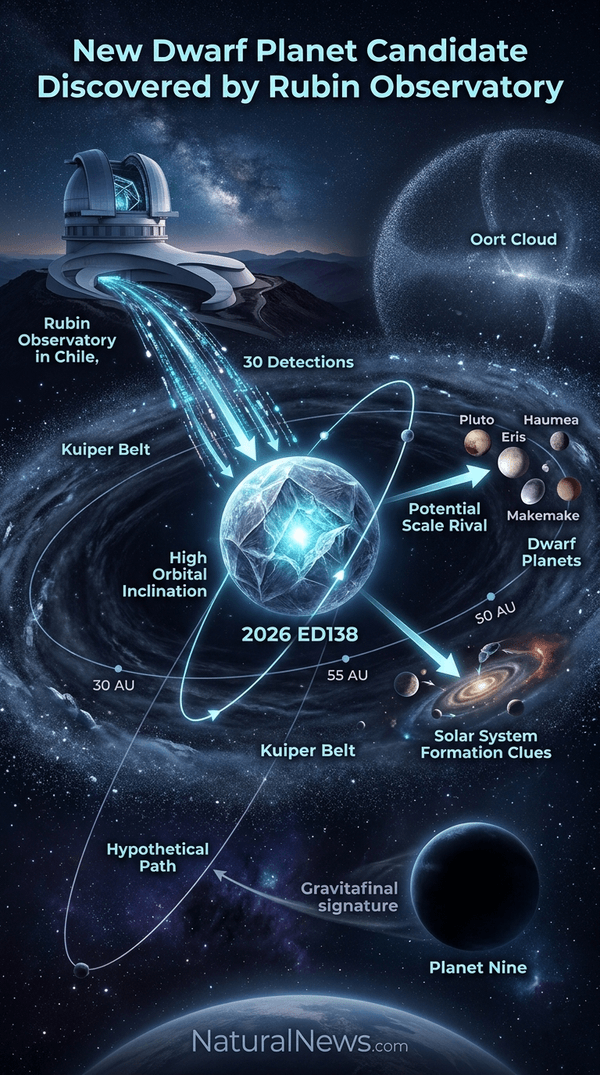
Astronomers have announced the discovery of a large object in the Kuiper Belt that appears to be a new candidate dwarf planet, designated 2026 ED138. The object was first spotted on Oct. 13, 2026, by astrophysicist Matthew Holman of the Harvard-Smithsonian Center for Astrophysics while he was analyzing observations from the NSF–DOE Vera C. Rubin Observatory in Chile [1][2].
One AU is the average distance from Earth to the Sun, about 93 million miles. If confirmed as a dwarf planet, it would join a group of only five other recognized objects that includes Pluto, the solar system’s former ninth planet [3].
Discovery Details and Object Characteristics
The team traced 2026 ED138 through 30 detections across 20 nights of Rubin observations between March 4 and July 11, 2026.
The object’s brightness and size estimates suggest that, if it is on the larger end of the range, it could rank alongside recognized dwarf planets such as Makemake and Haumea. The Kuiper Belt, where 2026 ED138 resides, extends from about 30 to 55 AU from the Sun. Beyond it lies the theoretical Oort Cloud, a distant shell of icy bodies that encircles the solar system [4][5].
The discovery adds to the thousands of trans-Neptunian objects already cataloged. The Kuiper Belt was named for Dutch American astronomer Gerard Kuiper, who in 1951 suggested a collection of bodies beyond Pluto, though the belt now known by his name differs from his original proposal [4]. Objects in this region are remnants from the solar system’s formation, and studying them offers clues about its early history [6].
Orbital Quirks and Detection Challenges
This high inclination means the object spends most of its time outside the narrow band of sky that traditional surveys routinely monitor.
The discovery demonstrates the Rubin Observatory’s ability to repeatedly scan large swaths of the sky and identify faint, slow-moving bodies that earlier surveys missed. This wide-field capability, combined with repeated imaging, allows astronomers to track objects over time and calculate their orbits.
The existence of a hypothetical Planet Nine, a world about 10 times Earth’s mass orbiting far beyond Neptune, has been debated for years, with some studies predicting its discovery within 10 to 15 years [7][8]. The new object’s orbit could provide additional data for those investigations.
Conclusion
The finding adds to the thousands of trans-Neptunian objects already known and suggests more remain undiscovered in the distant reaches of the solar system.
The discovery highlights the capability of the Rubin Observatory’s large camera.
The object’s provisional designation, 2026 ED138, indicates it was discovered in 2026. Further observations will be needed to confirm its size, shape, and orbital characteristics.
References
- NSF–DOE Vera C. Rubin Observatory Reveals Its First …. https://rubinobservatory.org/news/rubin-first-dwarf-planet-candidate
- Rubin Observatory reveals its first dwarf planet candidate in our solar …. https://www.washington.edu/news/2026/10/27/rubin-observatory-new-dwarf-planet-candidate/
- New dwarf planet candidate discovered in our solar system | CNN. https://www.cnn.com/2026/10/28/science/ed138-dwarf-planet-candidate-beyond-pluto
- NearEarth Objects Finding Them Before They Find Us. Donald K Yeomans
- Comets Visitors from Deep Space. by David J Eicher
- Astronomers investigate the relic of the primordial solar system – NaturalNews.com, June 19, 2018.
- Our solar system may have 9 planets again in a decade or so astronomers say – NaturalNews.com, September 04, 2019.
- Astronomers are still searching for the mysterious PLANET X – NaturalNews.com, January 25, 2023.
Explainer Infographic
Submit a correction >>
Tagged Under:
2026 ED138, breakthrough, cosmic, discoveries, Dwarf planet, Kuiper Belt, NASA, Oort Cloud, Planet Nine, Pluto, real investigations, research, Space, space exploration
This article may contain statements that reflect the opinion of the author
RECENT NEWS & ARTICLES