Ancient asteroid dust reveals a cold, new path for creating life’s building blocks
10/09/2026 / By Jacob Thomas
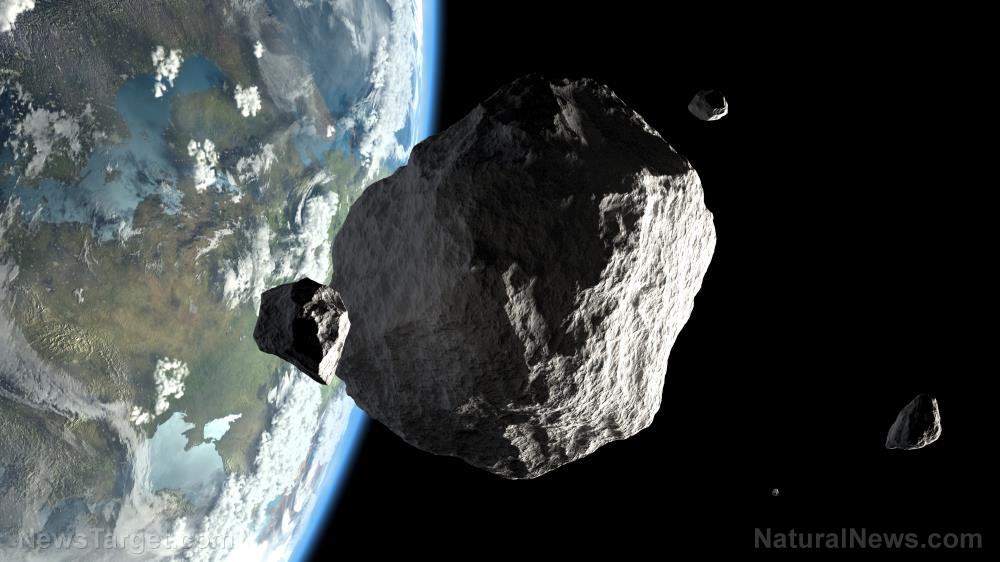
- Analysis of the asteroid Bennu’s dust reveals that its amino acids formed through cold, radiation-driven chemistry in space, not solely through warm, water-involved reactions as previously theorized.
- This finding challenges the dominant “warm and wet” origin story for life’s building blocks, showing they can form in the frozen, radioactive environments of asteroids without persistent liquid water.
- The distinct isotopic signature of Bennu’s glycine differs from that found in meteorites like Murchison, indicating these asteroids originated in chemically distinct regions of the solar system.
- The research vastly expands the potential environments in the universe where life’s precursors could arise and strengthens the theory that Earth was seeded with organic matter by asteroids and comets.
- Bennu’s samples show evidence of both ancient water-based reactions and cold radiation-based chemistry, suggesting a complex history where multiple processes contributed to creating a rich mixture of organic compounds.
In a discovery that challenges the warm, watery cradle of life’s origins, scientists have unraveled a cosmic mystery locked within dust from a 4.6-billion-year-old asteroid. The findings suggest the fundamental ingredients for life can form in the frozen, radioactive depths of space, potentially rewriting the story of how life’s precursors arrived on Earth.
The breakthrough stems from NASA’s OSIRIS-REx mission, which in 2023 successfully returned 121.6 grams of pristine material from the asteroid Bennu. Distributed to labs worldwide, this ancient rubble quickly revealed a treasure trove of organic matter, including sugars and amino acids, the molecular building blocks of proteins and, ultimately, life.
Previously, the dominant theory for amino acid formation in space centered on a process called Strecker synthesis, which requires liquid water and relatively warm conditions, similar to some environments on early Earth.
According to BrightU.AI‘s Enoch, “The Strecker amino acid synthesis involves reacting an aldehyde with ammonia and hydrogen cyanide (or a cyanide source like potassium cyanide) to form an aminonitrile, which is then hydrolyzed to produce an amino acid.”
But an analysis of Bennu’s dust, led by researchers at Pennsylvania State University, tells a dramatically different story. The team focused on glycine, the simplest amino acid. By using specialized equipment to measure subtle differences in the weight of atoms, known as isotopes, they created a chemical fingerprint of Bennu’s glycine. They then compared it to the signature of amino acids found in the famous Murchison meteorite, a carbon-rich rock that fell in Australia in 1969.
The result was a shock. The isotopic patterns were distinct.
“What’s a real surprise is that the amino acids in Bennu show a much different isotopic pattern than those in Murchison,” said co-lead author Dr. Ophelie McIntosh. “These results suggest that Bennu and Murchison’s parent bodies likely originated in chemically distinct regions of the solar system.”
Basic toolkit for life is not exclusive to warm, watery planets
This divergence points to a different origin story. While Murchison’s amino acids likely formed via warm, water-involved reactions, Bennu’s telltale signature points to a cold genesis.
The research, detailed in the journal Meteoritics & Planetary Science, indicates Bennu’s glycine formed as primordial ices on its parent asteroid were bombarded by radiation in the frigid environment of the early solar system. This process sparked chemical reactions that crafted amino acids without the need for persistent liquid water.
“Our results flip the script on how we have typically thought amino acids formed in asteroids,” said co-lead author Dr. Allison Baczynski. “There’s much more diversity in the pathways and conditions in which these amino acids can be formed.”
The implications are profound. It means the basic toolkit for life is not exclusive to warm, watery planets but can be forged in the cold, dark reaches of space. This vastly expands the potential environments in the universe where life’s precursors could arise.
Furthermore, it strengthens the theory that Earth’s own initial supply of organic matter could have been delivered by frozen asteroids and comets, seeding a barren planet with the potential for biology.
“It now looks like there are many conditions where these building blocks of life can form, not just when there’s warm liquid water,” Baczynski noted.
The discovery also adds a fascinating layer to the analysis of the Bennu samples, which had already shown evidence of past water interactions. Sections of the meteorite show evidence of chemical changes brought about by water from its parent asteroid, which sparked reactions that ultimately formed amino acids, some extremely rare in Earth’s terrestrial environment.
This suggests a complex history where both water-based and radiation-based chemistry may have worked on different timelines or in different locales on the asteroid to create a rich soup of organics.
Looking ahead, scientists are eager to test this new model against other celestial samples. “We want to know if they continue to look like Murchison and Bennu or maybe there is even more diversity in the conditions and pathways that can create the building blocks of life,” said Baczynski.
Each speck of asteroid dust is now a time capsule, and this latest reading suggests Earth’s cosmic origin story is colder, more radioactive, and perhaps more wondrous than humanity has ever imagined.
Watch this video about the building blocks of life found on an asteroid.
This video is from The Conspiracy Brief channel on Brighteon.com.
Sources include:
Submit a correction >>
Tagged Under:
Amino Acids, asteroid Bennu, astrobiology, breakthrough, cosmic, discoveries, extraterrestrial life, glycine, Murchison meteorite, organic matter, origin of life, OSIRIS-REx, radioactive synthesis, research, Space, space chemistry, space radiation, Strecker synthesis, weird science
This article may contain statements that reflect the opinion of the author
RECENT NEWS & ARTICLES