Magnesium Linked to Lower Atrial Fibrillation Risk, Study Finds
11/15/2026 / By Coco Somers

A meta-analysis published in June 2025 in the journal Heart International found that magnesium reduces the risk of new-onset atrial fibrillation after heart surgery, according to an account of the research published by NaturalHealth365.
Across the pooled randomized controlled trials, patients given magnesium had about a 45% lower risk of developing the rhythm disorder, although the certainty of that estimate was rated low. Atrial fibrillation is the most common heart rhythm disorder, and conventional care tends to focus on slowing heart rate with drugs and preventing clots with blood thinners, according to the same account.
The findings apply to surgical patients who were typically given magnesium intravenously, and the account states the results do not translate directly to everyday life. Magnesium has drawn increasing attention from researchers examining nutritional factors that may influence cardiovascular function. It is the fourth most abundant mineral in the human body and has been identified as essential for heart, kidney and muscle health, according to reporting published by NaturalNews.com [2].
Magnesium’s Role in Heart Rhythm
Magnesium takes part in more than 300 enzyme reactions in the body, and the heart ranks among its biggest users, according to the NaturalHealth365 account.
When magnesium runs low, heart cells become more excitable, firing when they should not, and the upper chambers of the heart can slip out of their normal rhythm, the account states. Low magnesium also helps drag potassium down with it, since the body needs magnesium to hold on to potassium.
The mineral has been described in peer-reviewed literature as a cofactor and regulator for the transport of other electrolytes that control the heart’s rhythm, including potassium, sodium and calcium [3]. A separate review published by the National Library of Medicine describes magnesium as a micronutrient implicated in maintaining and establishing a normal heart rhythm [4]. Textbooks on natural medicine likewise advise that food sources of magnesium are important for patients with arrhythmias [5].
Meta-Analysis Details
The June 2025 meta-analysis pooled randomized controlled trials on magnesium and new-onset atrial fibrillation after heart surgery, according to NaturalHealth365. Surgery is one of the most common triggers for an irregular rhythm, which the account describes as one of the clearest windows into the relationship between magnesium and atrial fibrillation [1].
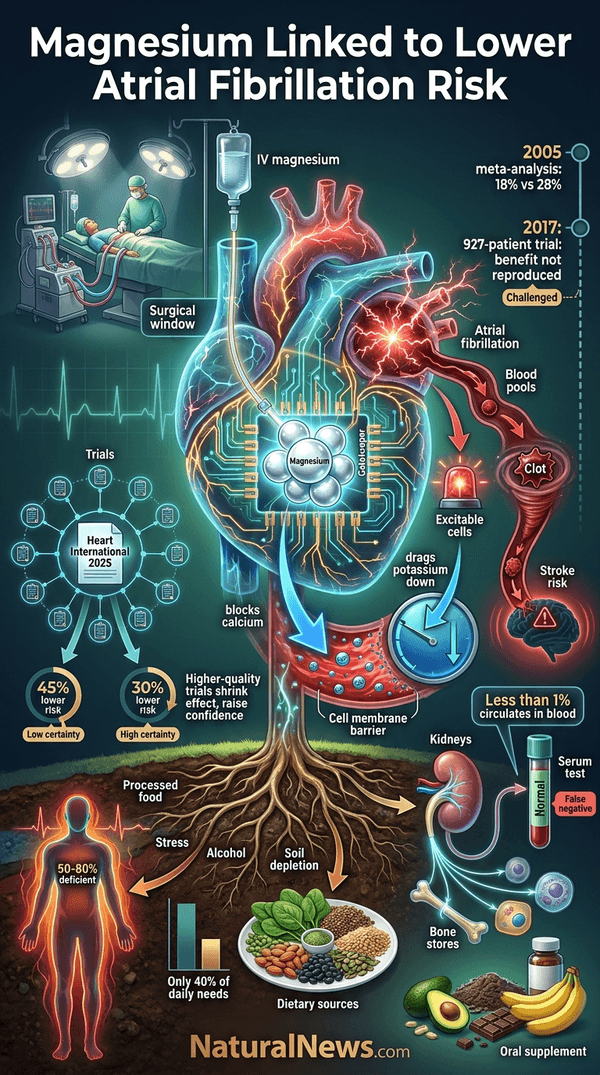
Across all trials, patients given magnesium had about a 45% lower risk of developing atrial fibrillation, though certainty in that estimate was rated low. In the higher-quality trials, magnesium lowered the risk by about 30%, a result the authors rated high certainty.
The authors concluded that magnesium reduces new-onset atrial fibrillation after surgery, according to the account. The finding is not the first to point in this direction. A meta-analysis published in 2005 involving 2,490 patients from 20 randomized controlled trials suggested that magnesium supplementation was effective in preventing atrial fibrillation in cardiac surgery compared with placebo, reporting rates of 18% versus 28% and an odds ratio of 0.54 with a 95% confidence interval of 0.38 to 0.75, according to a medical reference text [6]. The book notes that the results were subsequently challenged by a large randomized controlled trial involving 927 patients.
Testing and Prevalence of Magnesium Deficiency
Standard blood tests for magnesium can be misleading, according to the NaturalHealth365 account, because less than 1% of the body’s magnesium circulates in the blood. As a result, a blood test can appear normal while cells, including heart cells, run short.
Independent reporting published by NaturalNews.com states that magnesium deficiency is widespread, affecting an estimated 50% to 80% of Americans due to poor diet, stress, alcohol use and soil depletion, with only about 40% of daily needs met through diet alone [7]. A separate NaturalNews.com article describes magnesium as the “master mineral” because it is involved in over 300 metabolic functions, and notes that crops grown on depleted topsoil tend to carry less of it [8].
Conclusion: Magnesium and AFib
Food sources described as richest in magnesium include pumpkin seeds, almonds and cashews, spinach and Swiss chard, black beans, avocado and dark chocolate with 70% cacao or higher. A natural-medicine reference text recommends pumpkin seeds, spinach, quinoa, black beans and navy beans as food sources of magnesium [5].
The account cautions that people with kidney disease should not take magnesium supplements without medical supervision, since the kidneys clear excess magnesium, and that magnesium interacts with some antibiotics and other medications.
References
- Magnesium and AFib: The Heart Rhythm Link | NaturalHealth365. https://www.naturalhealth365.com/magnesium-and-afib.html
- Magnesium and Heart Health: Three Key Benefits Supported by Experts – NaturalNews.com, June 22, 2026.
- Atrial Fibrillation – CardiacBulletin. https://cardiacbulletin.net/blog/article?id=199
- The Role of Hypomagnesemia in Cardiac Arrhythmias: A Clinical …. https://pmc.ncbi.nlm.nih.gov/articles/PMC9598104/
- Prescription for Natural Cures A SelfCare Guide for Treating Health Problems with Natural Remedies. Mark Stengler
- Magnesium in Human Health and Disease. Unknown
- The quiet hero: Magnesium’s role in heart health – NaturalNews.com, June 15, 2026.
- Six reasons magnesium is an essential supplem – NaturalNews.com, December 24, 2012.
Explainer Infographic
Submit a correction >>
Tagged Under:
#nutrition, arterial stiffness, atrial fibrillation, blood pressure, Cures, diet, food, food science, health science, Heart, heart disease, heart health, heart rhythm, heartbeat, longevity, Magnesium, natural health, natural medicine, nutrients, research, reverse heart disease
This article may contain statements that reflect the opinion of the author
RECENT NEWS & ARTICLES