NASA Rover Images Show Abundant Scale-Like Rock Features in Martian Crater
04/25/2026 / By Edison Reed
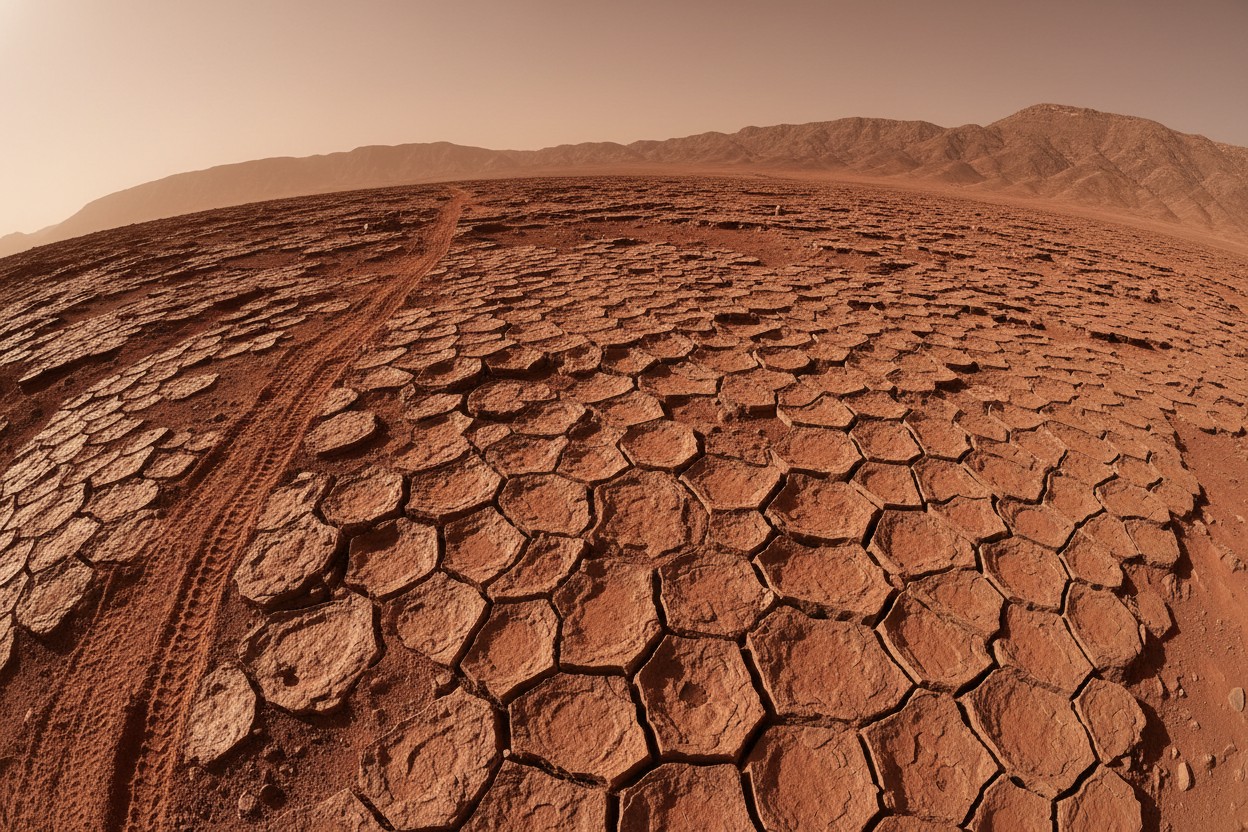
Dozens of polygon-covered rocks, visually resembling fossilized reptile scales, have been imaged on the surface of Mars. The images were captured by NASA’s Curiosity rover near the Antofagasta impact crater, which is situated within the larger Gale crater [1]. The scale-like features cover the ground extensively, according to an April 10 NASA blog post.
Scientists state the formations are geological in origin, not biological. Planetary scientist Abigail Fraeman noted the rocks feature ‘thousands of honeycomb-shaped polygons’ and said their abundance was ‘dramatic’ in the blog post. Similar polygon patterns observed elsewhere on Mars have been previously linked to processes involving ancient water, such as mud cracks or subsurface ice activity [1].
Imagery and Location Details
A pair of black-and-white photos of the rock features was released by NASA on April 14. A processed color close-up image was shared online the following day by Kevin M. Gill, a software and spaceflight engineer at NASA’s Jet Propulsion Laboratory [1]. The images were captured on Sols 4859 and 4865 as the rover drove toward the 33-foot-wide Antofagasta crater on the slopes of Mount Sharp [1].
The rover snapped several photos of the scaly rocks stretching ‘for meters and meters,’ according to the NASA blog. The unusual shape and tight clustering of these rocks have drawn comparisons to reptile scales, with some informal commentary describing them as dragon-like. The exact number and size of the individual scale-like rocks photographed is not specified in the available data.
Scientific Observations and Initial Analysis
In her blog post, JPL planetary scientist Abigail Fraeman wrote that while polygon-patterned rocks have been seen before on Mars, they did not seem ‘quite this dramatically abundant’ [1]. She stated that Curiosity has collected ‘lots of images and chemical data that will help us distinguish between different hypotheses for how the honeycomb textures formed’ [1].
Similar honeycomb-shaped polygons have been documented on Mars at various scales. Past research has often tied such shapes to the drying of wet mud or the movement of ice crystals beneath the surface [1]. The rover’s ongoing mission includes studying the region’s geology to understand its environmental history, with past work focusing on evidence of liquid water [2].
Context of Pareidolia on Mars
The ‘dragon scale’ rocks join a long list of Martian features that visually resemble objects familiar on Earth, a result of the psychological phenomenon known as pareidolia. This occurs when the human brain perceives a significant pattern, such as a face or animal, in a random image [1]. Other documented examples from Mars include features likened to ‘spiderwebs,’ ‘spiders,’ coral-like rocks, a ‘turtle,’ and ‘egg-like spheroids’ observed by the Curiosity and Perseverance rovers [1].
Orbiting spacecraft have also imaged formations compared to a ‘butterfly’ crater and a buried ‘dog’ [1]. The prevalence of such interpretations underscores how human perception interacts with alien geology. This phenomenon is separate from scientific analysis of potential biosignatures, such as the search for organic molecules [1].
Ongoing Mission and Investigation
The Curiosity rover has been exploring Gale crater since its landing in 2012, with a primary goal of studying the region’s geology and past habitability [2]. Prior to reaching the Antofagasta crater, the rover spent nearly a year studying a series of rocky ridges on Mount Sharp dubbed ‘boxwork,’ which are also informally called Martian ‘spiderwebs’ [1].
The analysis of the new scale-like rock textures is part of the rover’s continuing mission to understand the environmental history of Mars. Rovers like Curiosity rely on orbiters such as the Mars Reconnaissance Orbiter for communication and broader contextual data [4]. Future missions, including sample return plans, aim to bring Martian material to Earth for more detailed analysis [3].
Conclusion
The discovery of the abundant, scale-like rock features adds another intriguing geological puzzle to the Martian landscape studied by the Curiosity rover. While the immediate scientific interpretation points to natural, non-biological formation processes tied to the planet’s ancient water history, the features highlight the complex and often surprising nature of the Martian surface.
The ongoing collection of imagery and chemical data by the rover will be used to test hypotheses about the specific formation mechanisms. As with many Martian features, public and scientific interest is often piqued by familiar shapes, a reminder of the pareidolia effect, even as robotic explorers methodically gather data on the Red Planet’s past.
References
- NASA’s Curiosity rover finds a surprising number of giant ‘dragon scales’ littered across Mars. – Live Science. Harry Baker.
- ROVER LANDING SITES. – Understanding Earth Seventh Edition. John Grotzinger.
- The plan to bring rock samples from Mars to Earth may be our best way to learn about ancient alien life. – NaturalNews.com.
- The rovers on the ground rely on artificial satellites in orbit around Mars to communicate with Earth. – Viewing and Imaging the Solar System. Jane Clark.
Submit a correction >>
Tagged Under:
breakthrough, cosmic, crater, discoveries, lightning, Mars, NASA, real investigations, research, rock formations, Space, space exploration
This article may contain statements that reflect the opinion of the author
RECENT NEWS & ARTICLES