Interstellar comet 3I/ATLAS erupts with icy volcanoes, forcing scientists to rethink cosmic history
12/04/2025 / By Cassie B.
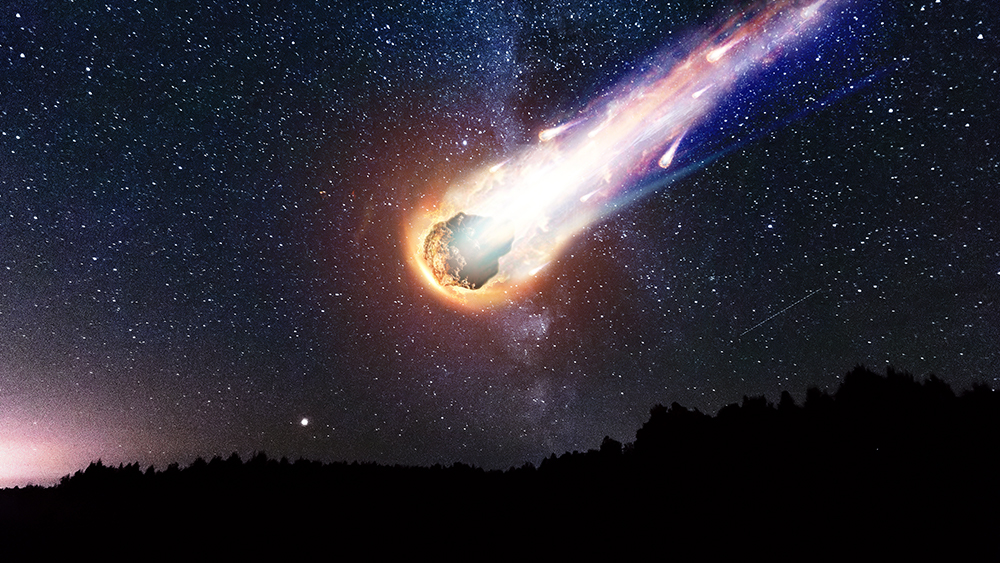
- An interstellar comet erupted with global icy volcanoes as it entered our solar system.
- Its pristine, metal-rich composition defies standard models of comet formation.
- The comet lacked a protective dust layer, causing its entire surface to activate.
- Its chemistry matches rare meteorites that may have seeded Earth with life’s ingredients.
- This visitor forces scientists to rethink how planetary systems form across the galaxy.
A pristine messenger from a star system born billions of years before our own is rewriting the cosmic rulebook right before our eyes. Between July and November of 2025, an international team of astronomers trained their telescopes on the interstellar comet 3I/ATLAS as it screamed through our solar system at 130,000 miles per hour. What they witnessed was not just a simple icy dirtball, but an active, erupting world covered in “icy volcanoes,” powered by a metal-rich interior that directly contradicts established science. This isn’t just about one strange rock; it’s a direct challenge to our fundamental understanding of how planets and comets form, both here and across the galaxy.
The comet presented a once-in-a-lifetime opportunity. As a pristine object that had never passed close to a star, it remained an untouched relic of its birth, billions of years ago in a now-distant planetary system. The scientists tracked it carefully as it approached the sun, expecting typical cometary behavior. Instead, they documented a dramatic and sustained surge in brightness when the comet was still 2.5 times the distance from Earth to the sun.
A global eruption of ice
This was not a sudden explosion. The sustained brightening indicated the activation of water-ice across the comet’s entire surface. The research team, in a study posted on the arXiv preprint server, concluded the most likely explanation is cryovolcanism. Unlike the fiery volcanoes of Earth, cryovolcanoes erupt with water, gases, and other frozen materials. It has been seen on distant moons in our solar system, but such global activity is extraordinary for a comet.
The key lies in what 3I/ATLAS lacks: a protective dust mantle. Comets from our own solar system accumulate a dusty crust that insulates their ice. This interstellar visitor, having drifted in the deep freeze of space for eons, has no such blanket. When sunlight finally reached it, the reaction was immediate and planet-wide.
A metallic heart from another star
The surprises deepened when researchers analyzed the light reflecting off the comet. Its chemical fingerprint matched a rare and ancient type of meteorite found on Earth called a carbonaceous chondrite. These meteorites are known to be rich in metals like iron and nickel. This match suggests 3I/ATLAS shares that unusual metallic composition.
This discovery is revolutionary. Standard models of comet formation assume these bodies are made of ice, rock, and only trace amounts of metal. 3I/ATLAS, forged around another star, is packed with it. The scientists propose this metal is the engine for its cryovolcanoes. As surface ice melted, water seeped into the interior and began to corrode the fine metallic grains. This chemical corrosion releases extra energy and gases like carbon dioxide, fueling and sustaining the icy eruptions in a way solar heating alone cannot.
The implications are staggering. It means the processes that build small bodies around other stars can produce fundamentally different chemistries and structures than those in our solar system. As the study authors note, “Interstellar visitors like 3I/ATLAS continue to challenge and refine our understanding of planetary-system formation.”
This alien comet, a frozen artifact from a forgotten solar system, is more than a scientific curiosity. Its metal-rich, volatile nature mirrors the carbonaceous chondrites that scientists believe seeded the early Earth with water and the organic compounds necessary for life. Its journey tells us that the ingredients for worlds and perhaps life itself are not only universal but come in a far greater variety than we ever imagined. The universe just sent us a sample from its deep past, and it is forcing us to rethink our own origins.
Sources for this article include:
Submit a correction >>
Tagged Under:
3I/ATLAS, breakthrough, Collapse, comet, cosmic, cryovolcanism, cryovolcanoes, discoveries, icy volcanoes, interstellar comet, meteorites, real investigations, research, Space, space exploration, volcanic eruption, weird science
This article may contain statements that reflect the opinion of the author
RECENT NEWS & ARTICLES